Friday, 22 July 2016

Day 3. Musee d'Orsay - great for lovers of Impressionism

Today, we visited the Musee d'Orsay, a museum which is located in a former Beaux-Arts railway station.  The building is wonderfully over the top in some ways, partly in its lights, decorative finishes and clocks, 


but also in the way it juxtaposes ultra modern elements with the past.  For instance, I loved the way the restaurant  used these lolly coloured plastic chairs 
 

and the cafe these golden light covers and colourful wire dividers..


The collection of the museum focuses on the period between 1848 and 1900, and gives the visitor a wonderful opportunity to view Impressionist and Post-Impressionist artists and gain an understanding of how the artists learned from each other and developed their own individual techniques and styles. Visiting the museum had me itching to go back to using oils and experimenting with paint.
Artists included  Gauguin, Monet, Van Gogh (eg " L'Eglise d"Auvers-sur-Oise, vue du chevet")


Henri de  Toulouse-Lautrec ( eg "Dame au Boa Noir")


Renoir,  Millet, Degas and Pisarro.  Some of the other works we came across were "La Femme a la Cafetiere" by Paul Cezanne


Claude Monet's studies on "La Cathedrale de Rouen",


Claude Monet's "Le Bassin aux Nymphes, Harmonie Verte",


"Vue des Toits (Effet de Neige)" by Gustave Caillebotte 


and  "La Dame aux Eventails" by Eduard Manet.


The collection also includes sculptures, including this one by Edgar Degas, "Petite Danseuse de Quatorze Ans",

Francois Pompom's owl,


 Auguste Rodin's "La Pensee"


"Le Grenouillard" by Jean-Joseph Carries


and Jean-Baptiste Carpeaux's  "Les Quatre Parties du Monde Soutenant la Sphere Celeste".  I found this latter sculpture  very amusing.  It purports to portray female representatives of Europe, Asia, North America and Africa, but all the women are very European in appearance and they all have very European bodies.  The African representative is manacled.


There is also, in the museum  a section dedicated to Art Nouveau which I found very interesting


If you go to the Musee d'Orsay, don't forget to look out the windows for some magnificent views too:


I loved this museum.  It is really worth visiting

Thursday, 21 July 2016

Paris Day 2. The Ile de la Cite, the Right Bank and the Boulevarde Haussman

We decided to walk less and use the Metro more so we could perspire less, limp less and travel about more.  Gradually, as we travelled, our understanding of how the Metro system works, our appreciation of the frequency of the trains and our understanding of the diversity of the local population increased.  I think we had vaguely assumed that Parisians would all look like the cast from a Gerard Depardieu, Audrey Tatou or Juliette Binoche movie. We had also expected skinny elegant women to slink around looking impossible gorgeous.  In fact, and quite reassuringly, we have encountered a very multicultural and varied  population.  The French here vary in appearance from blond, blue eyed Northern European type people, to very Mediterranean tanned brunettes, to North African / Arabic types to more southern African tribal members, to West Indians.  There are Vietnamese looking Parisians, Chinese looking Parisians and Parisians of mixed race.  Quite obviously, Paris has been a magnet for immigrants from its former colonies.  There are quite obviously class and income differences and differences in body types and the way people dress.  As my fellow traveller pointed out, if Parisians have the reputation of all being thin, it is probably more because of the amount of steps you have to climb going up and down in the metro, than because of reality.  I would add that even older people use scooters, skateboards and bicycles to get around, and most people walk a lot. Yes, there are quite a few slim, well dressed people around, but not everyone is like that.

 Today, we decided to explore the  Ile de la Cite.  We emerged from the metro into a collection of garden nurseries, all stocked with rather contorted looking olive trees and other potted plants for Parisians to decorate their balcony gardens and roof top gardens. We wandered rather aimlessly around the Conciergerie,


where Queen Marie Antoinette was held before her execution, and then strolled over to the famed Cathedrale de Notre Dame de Paris which still works as an active church, in spite of the amount of tourists visiting it.


The cathedral represents the power and wealth of the Roman Catholic Church


and the devotion of its followers,


but far more impressive, to me, is the amazing craftsmanship was needed to create the lovely and colourful stained glass windows,


and the carvings.


My favourite elements are the decorative elements outside, especially the gargoyles and devils, which seem so incongrously pagan given the intention of the building.


Unlike a lot of the cathedrals I have seen in Spain, which are carefully being restored, this cathedral is quite badly damaged by time.  I wonder whether there is a shortage of funds for repairs, or whether it is a conscious decision to keep the building authentic.  Either way, future visitors are likely to find more and more damage over the years unless something is done soon.

 We continued to explore the Ile and ran into the rather violent looking Charlemagne.


Then, we crossed to the left bank of the Seine and walked along the waterfront where we got some beautiful views of the Cathedral


and  the suburbs west of the Ile.


 On the way, we came across these two amusing pieces of street art:


 After that, we crossed to the right bank and walked up towards Saint Eustache cathedral,


then through the disappointing Jardin Nelson Mandela, which are being restored but look like a wasteland at present, past the weird looking bulb of Agro Paris Bourse, through the back roads to a rather uninspiring lunch in an extremely atmospheric restaurant complete with an elderly, but extremely theatrical waitress who informed and charmed in equal measure.

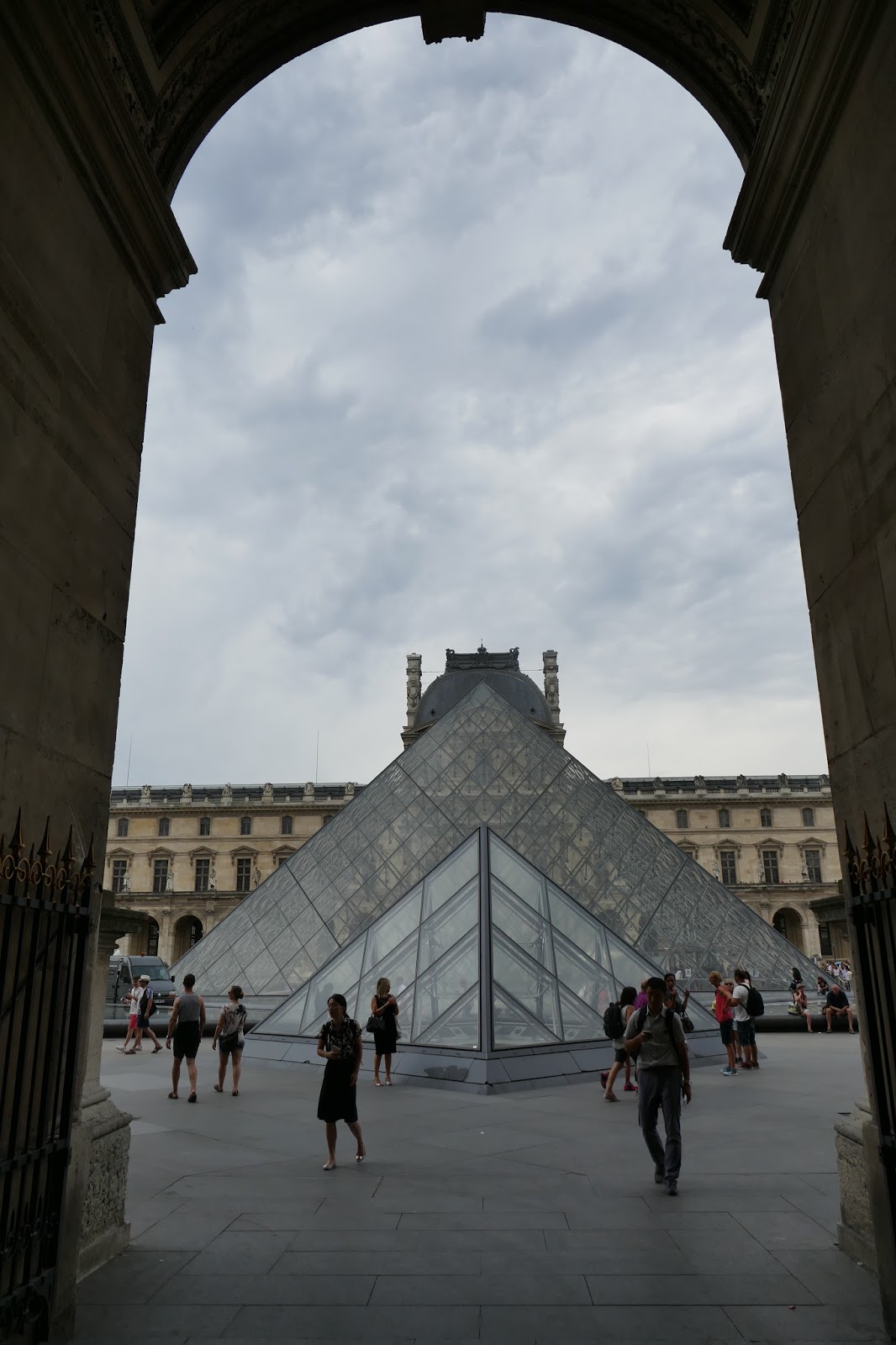
Next was a walk around the  Louvre with its crowds


past the Arc du Triomphe du Carousel


to the Jardin des Tuileries,


where we did what the locals do.  We sat under the trees with our feet up, ate ice creams and watched the ducks in the duck pond, while eavesdropping on two youths having a tearful heart to heart.  Was it love for each other, as Bob suspected, or love for another?

In the evening, we left the hotel to explore the shops in the Boulevade Haussman.  You can buy cheap or you can buy very, very expensive.  Bob bought a very necessary hat.  I got depressed and bought nothing, but marvelled at the ostentation of the Galeries Lafayette Haussman.


Paris. Day 1

After many years of wishing, planning, booking and cancelling a trip to France, we have finally made it to Paris!

We are staying in a little hotel in Montparnasse, close to Raspail station and the Montparnasse Cemetery, called Hotel de la Paix in the 14th Arrondisement.  It is hard to believe that this area was frequented by artists like Picasso,Chagall, Modigliani, and political types like Lenin and Trotsky in the past, for today it is a fairly quiet area, even though it still has plenty of cafes and restaurants and has easy access to transportation.

We arrived in the morning after a very long trip from Melbourne via Abu Dhabi, and after a much needed shower and a change of clothes decided to explore as much as possible before our bodies collapsed.

We found a local restaurant, with warm friendly staff who proceeded to destroy the reputation of Parisians as being snooty and arrogant. Our  half Russian waitress spoke to us in French, English and Spanish and was very helpful in helping us improve our French and understand what we were eating.  How lovely to be in a country which values the importance of fresh vegetables and well cooked food.  So often, when we travel, we miss the presence of vegetables in a meal.  We can tell that this will not be the case in Paris.

Following our custom of exploring a new city by foot and meandering without a plan, following our noses, so to speak, we walked to the Jardin du Luxembourg.


The 23 hectare gardens were full of people sun-bathing, eating ice-creams and strolling under the shade of the trees.  The day was so hot that many were cooling their feet in the water features.  We decided to stick to routes under the trees to avoid expiring.  I'm not really a fan of baking in the sun.


The central focus of the gardens, the Palais du Luxembourg, which was built in the 1620s for Marie de Medici was fenced in for renovation and patrolled by heavily armed, very hot looking police, but was still very impressive.


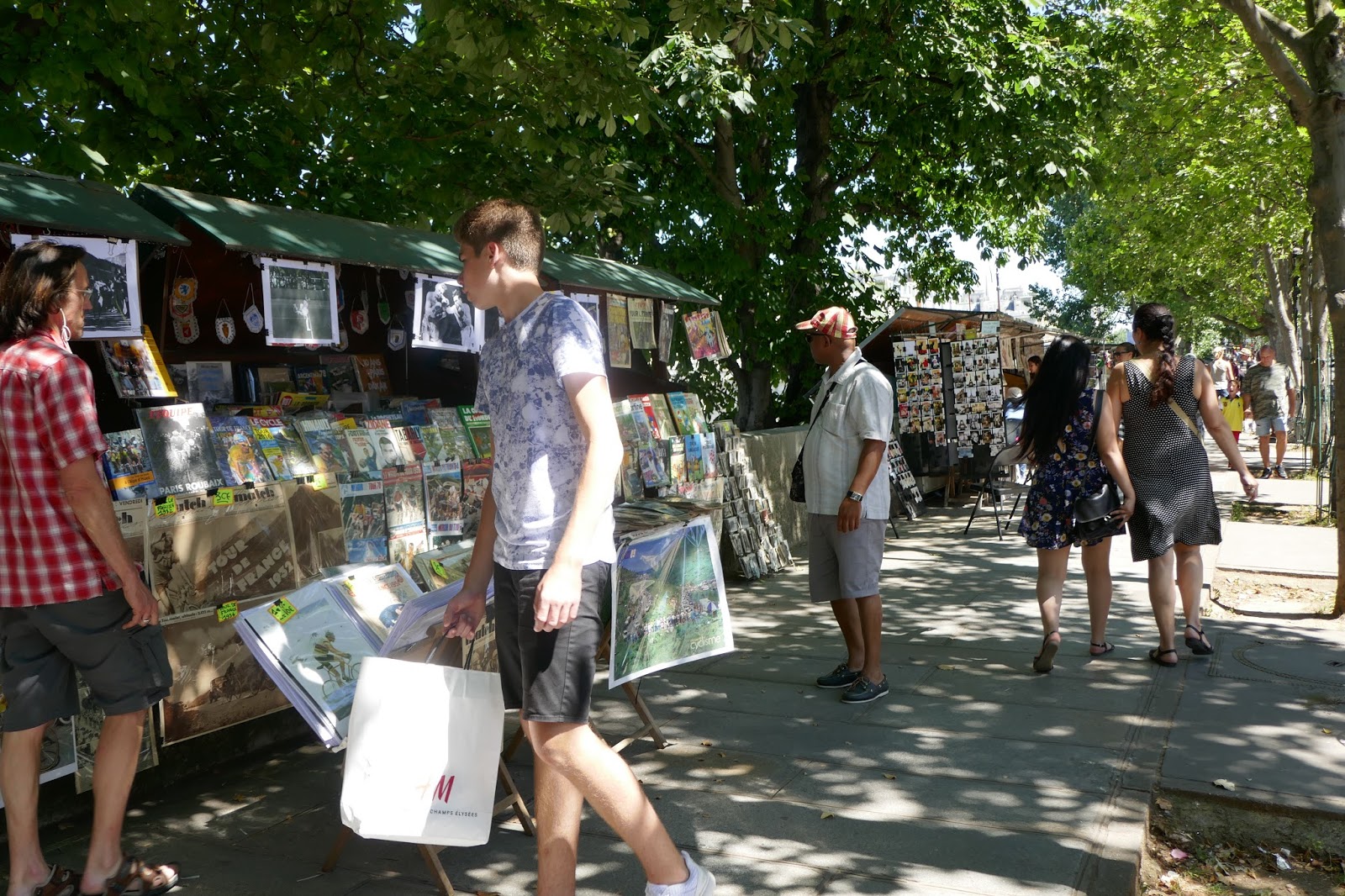
We then wandered through the back streets of St. Gemain until we found ourselves on the banks of the Seine.  Strolling along this famous walk, so much of it seems familiar:  the book stalls my father used to frequent,


the Ile de la Cite


and the bridges.


I think I was most surprised at how completely the river has been civilised by being lined and sealed off.  I was most delighted at the presence of barges used as homes, restaurants and cargo transport.


 Heat stroke, exhaustion and jet lag hit us and we decided to use our weekly transport card to return home.  Unfortunately, fried brains combined with unfamiliarity with the metro system had us wandering round St. Michel for ages, but we finally figured it out and returned, hot, red, sunburned and sticky to drop into a deep sleep as soon as our heads hit our pillows.