Monday, 8 June 2015

Istanbul Day 10: A trip to the Asian side of Istanbul

We decided to take a ferry cruise from Eminonu to the Eastern side of Istanbul, Uskudar. We found out that we could use our travel card so it was a very easy and very cheap trip, costing only about $1 AUD each way.   we managed to get a close look at the Istanbul Modern on the way over, plus get more snaps of the city.


It turned out that this excursion was a favourite Sunday outing for the locals too.   Once we got off the ferry, greeted by a very loud call for prayer from the loudspeakers of the mosque opposite the terminal, we strolled with the other couples along the foreshore and watched the fishermen hauling in little sprats from the sea.


A bit further on, we came upon old ladies in traditional dress of baggy floral trousers, tops and scarves selling flowers and floral crowns.  Two men were also each standing beside box containing a white rabbit.  The box was on a stand.  was it preparation for a magic trick? Later, we saw an area where cushions and umbrellas were set up on the stairs by the foreshore.  There, couples drank Turkish tea, smoked and feasted on sunflower seeds, looking out at the view, which included an intrepid swimmer being swept out to the Sea of Marmara.


 We watched boats taking visitors out to the Maiden's Tower where there is a popular cafe.


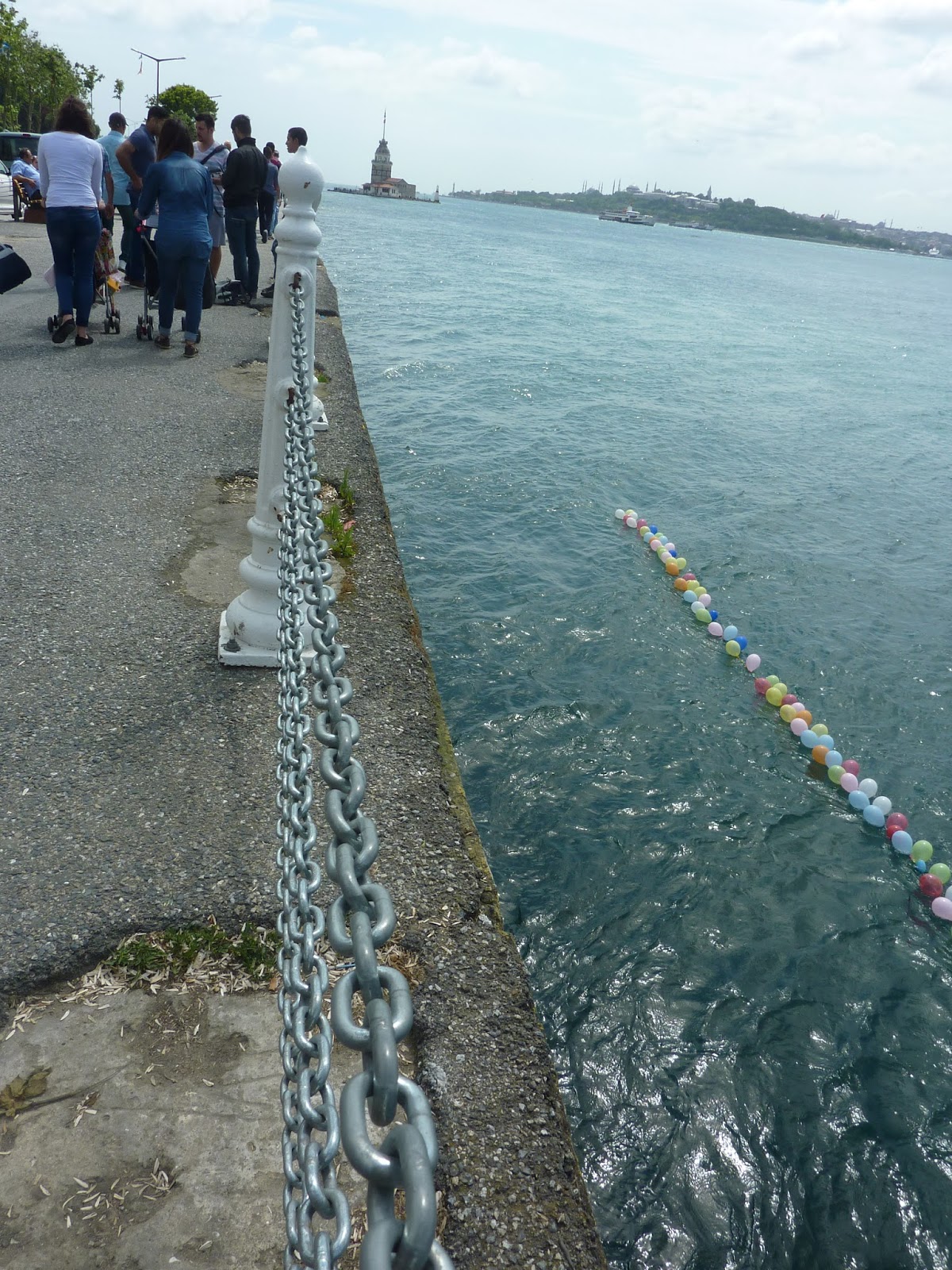
We had lunch and then strolled along the foreshore.  We came across a line of balloons in the water.  Turns out that you can rent a gun and use them for target practice.


Next, we strolled into the town and through a park where the oldies watched the world go by.  The town was decorated with vertical gardens like this one.


Then, we came across the inevitable market and bought a kilo of cherries for 7 lira.  We should have bought more.  They were scrumptious.


We would have liked to buy some of the ceramic cookware too but they looked a bit heavy.


 When we left, we got a view of the area we had strolled past, the locals still sitting under their umbrellas, chatting and relaxing.


In the evening, we ate our cherries and then went to Sultanhamet Park and ate freshly cooked corn in the dark, watching the world go by from the glow of the fountains.


 The next two days, we spent just walking around, shopping and sightseeing.


What an astounding experience this has been.  The two areas we have visited have been complex, interesting places, and the people of Turkey are very difficult to define clearly and to generalise about.  In many ways, we have been surprised at how open the Turks are to those who do not follow Islam - no one appears to blink an eye at the assertiveness of  the female tourists, the way foreigners and some locals dress, the requests for alcohol at meals.  And yet, there are reminders that what is okay for tourists is not okay for many locals, and that this is a mainly Islamic country  Only men work in most shops, more men frequent the cafes than women, alcohol is not served in most places out of the main tourist areas, I have never seen pork offered for sale, many of the tourists are from Islamic countries.  We learned so much during this trip and we have so much more to learn.  For instance, why did a lot of the travellers at the airport appear to be wearing towels as bath slippers as their mode of dress for getting on planes?  Hopefully we will visit Turkey again and learn more.

Sunday, 7 June 2015

Istanbul Day 9: the Pera Museum and Grayson Perry's "Small Differences"

Today, we crossed the Golden Horn to visit the Pera Museum.  I was really excited because they were showing an exhibition of Grayson Perry's work, and he is one of my favourite artists.  I was rather surprised in one sense because his art can be very graphic and confronting, and he is a cross-dresser, but then, upon reflection, a lot of his themes are relevant to Turkey today too.  Plus, his humour and social commentary are appealing.

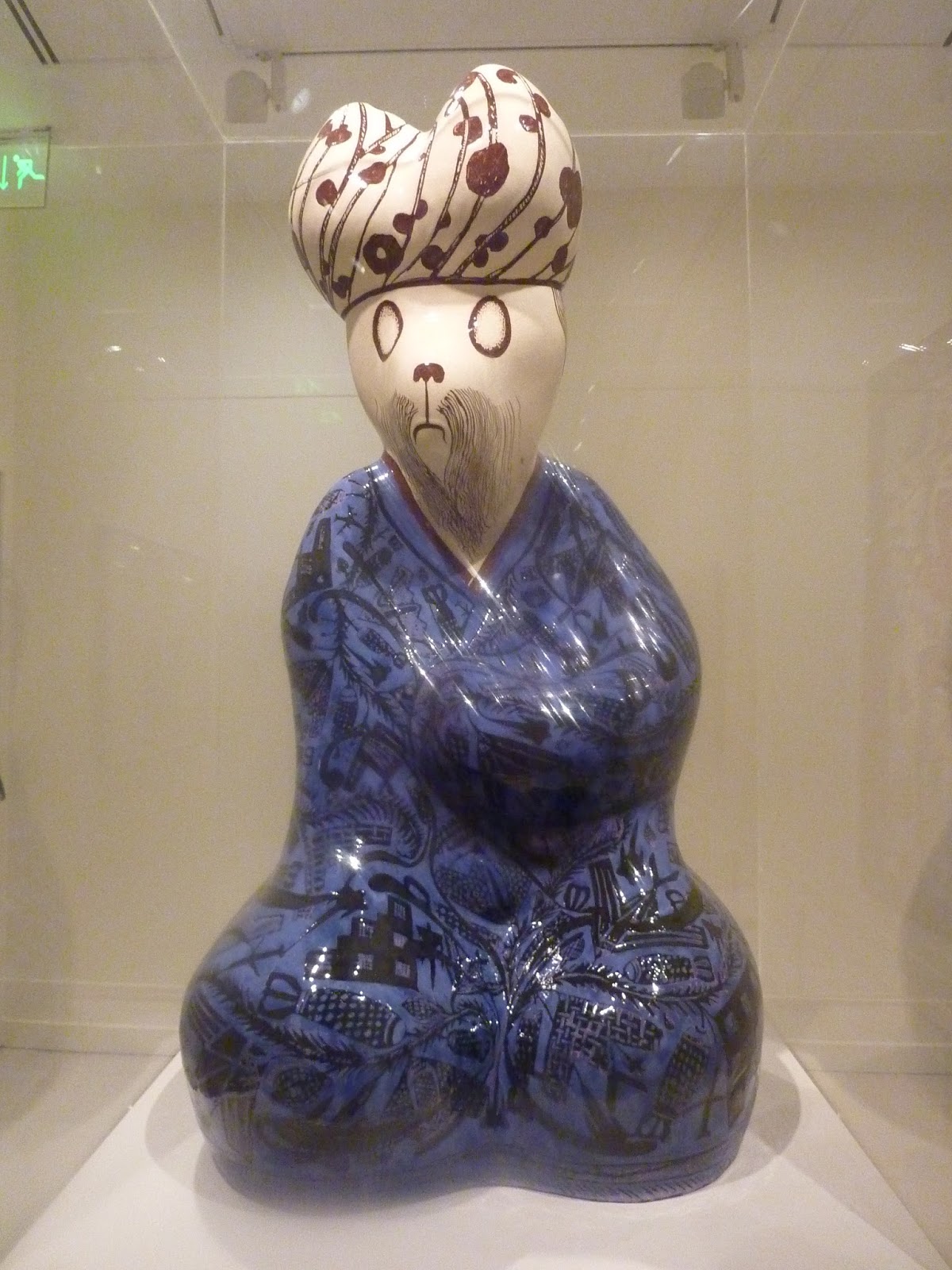
The "Small Differences displayed some of his ceramic work, mostly his large vases, but there was also this Islamic depiction of his teddy bear, Alan Measles, called "Wise Alan".


Included in the exhibition were some of his works on paper.  I like the idea of his mind maps.  This etching is called "Map of an Englishman" and is as amusing as a lot of his other works.


A larger etching is called "Print for a Politician" and looks at the battles between factions.  Bob and I felt that there wasn't enough correlation between the illustrations and the words, but his illustrations were incredible.


The main pieces of work on display were the six large tapestries, "The Vanity of Small Differences", which I had previously seen in his documentary on television, "All in the Best Possible Taste with Grayson Perry".  They are inspired by William Hogarth's "A Rake's Progress" and the exhibition had plates from Hogarth's etchings on display too.


Perry's  character is called Tim Bakewell and the story follows his development from birth to death. I am only displaying small images from each of these large tapestries in this blog.  The first in the series is the"The Adoration of the Cage Fighters" and depicts Tim as a baby with his working class mother:


The second is "The Agony in the Car Park" depicts Tim's stepfather and Tim's growing embarrasment at his family:


"Expulsion from Number 8 Eden Close" depicts  Tim moving away from his parents and into the middle classes.


In "The Annunciation of the Virgin Deal", Tim is now very wealthy and in his second home, surrounded by his new family.


By "The Upper Class at Bay", Tim realises that however much new money he makes, he will never become part of the upper class, in spite of the landed elite gradually dying out.


The last tapestry, "Lamentation", shows Tim, dead from a car accident and in the arms of a stranger, while his second wife looks on.


The exhibition also includes his sketchbooks, which are very interesting.


Two tapestries that Turkey allowed to be displayed in spite of them being fairly provocative in a religious sense are the "Map of Truths and Beliefs"


and  "Vote Alan Measles for God"


The Walthamstow Tapestry on the other hand could have been rejected for other reasons.


Turkey is to be commended for showing these pieces and recognising their importance as works of art with a social commentary.

The Pera Museum also had an amazingly good exhibition of Cecil Beaton photographic portraits which we enjoyed  very much, and a display of Anatolian Weights and Measures, an exhibition of "Ambassadors and Painters"  and an examination of coffee in Kutahya tiles and ceramics.

After the exhibition, we descended Istiklal street with its nostalgic tram occasionally running through the crowds of people to the Golden Horn.  


 On our way down, we passed the child beggars which are the exception to the general regard for children shown in Turkey.  Apparently many of the beggars are Syrian refugees who reject the government support system, and others are used by poorer Turks as money making tools.   Some, and I did not see any of these, are reputedly deliberately maimed to raise more pity.  It upset me to see some of these children looking dirty and wild and uncared for.  Some of the little ones are so limp that I suspect they are drugged.  I can see why the Turks are disturbed by this phenomena and why some of these children have been removed from their parents.  I know that I am only seeing the surface of the problem, but I hope that less children will be forced to beg in the future, and less adults will feel the need to use children this way.

Istanbul Day 8: the Grand Bazaar


We have been deferring visiting the Grand Bazaar partly because we have felt more like exploring than shopping and also because we couldn't face fending off more salesmen.  The Turkish salesman are charming and always insist that you do not need to buy, just look.  They give you great stories about their products and their country.  They have a sense of humour.  And, they are generous - making you comfortable and plying you with tea and coffee.  The trouble is, Bob and I hate being rude and feel guilty if they spend time on us and we don't buy anything.  As it was, we had nothing to fear.  The salesmen in the Grand Bazaar and much less pushy than those near the Blue Mosque and, as we went in the morning, the crowds were not huge.  

There are several entrances but they are not very clearly marked and merge into the side alleys, which sell slightly cheaper wares since their overheads are not as high.


 Inside, you get a strong idea of what it must have been like years ago and  it is surprisingly light, roomy and colourful.


It is a bit overpowering with the sheer multitude of things you can buy, the quality of the goods and the fact that so many shops sell similar things.  There is gold, gold gold, gold, soap, oils,  cushions, leather, bags, silver, antiques, food..... the list goes on.


You could spend a day in here, but we were unable to buy a thing, partly because the prices were a bit high and partly because we were overwhelmed, so we had a coffee in one of the cafes and then escaped the arcades


for the much more overcrowded side streets, where we did what we do best: watched people and marvelled at the sights.


 The one thing that we have learned about the Turks is that they all look very different.  Some look like Indians, some like Greeks, some look very Asian and some look very Western European.  Some wear traditional regional dress, some dress like any modern Westerner.  The interpretion of Islam is similarly varied. Some women wear black abaya and niqab, but more wear a coloured head scarf and a long coat like garment.  Some women only wear a headscarf with Western clothes. Most men wear no headwear but some wear a crocheted skull cap and some a sort of embroidered fez. Some men wear traditional baggy pants and a waistcoats, some women wear colourful baggy pants and a floral top.  There is no rule to dress but the richer people tend to dress more like westerners.

On Sundays, some families dress up their little bys like sultans and their little girls in frilly dresses.


One of the loveliest things about the Turks is their adoration of children.  The kids are almost spoiled and very feisty but the parents look at them adoringly, as does everybody else.  The dads are delightfully hands on and very doting.  And family is very important.  You often see the extended family all shopping together.

The Turks are also very tactile and show affection openly.  Boys look lovingly into their girlfriends' eyes,  men walk arm in arm with men, and women with women - and they are heterosexual.  We have seen 2 male friends in a park, one lying on the other's lap, and they are not gay - just friends or relatives.  I know that homosexuality is "discouraged" here, which is sad, but it is nice to see people so comfortable with affection.

We really didn't take many photos today. Just these ones of some rather rare graffiti art:


Istanbul, Day 7: A visit to Istanbul Modern


Today, we decided we felt confident enough to handle the tram system again and headed for the Istanbul Modern to see what Turkish art was like.  We missed the stop and had to go back again, but this gave us the opportunity to see an old man sitting in the park with his ducklings and 3 dogs.  Amazingly, the dogs ignored the ducklings.  Mine would have devoured them in a second!

 Istanbul Modern was not the red scaffolding building we thought it was but was a fairly bland looking building accessed via a construction site and a car park.  However, it is on the water's edge so has great views.  And there are some sculptures in the "garden" outside, like this one by Richard Deacon, called "House Version".


Inside, we were greeted by this huge bright work by Elkin Yalkindag, "Contrasts"


and this one by Fahrelnissa Feid, "My Hell".


Not all the works were this abstract.  This more realistic one is by Ash Torcu and is called "Circumcision Feast:


and this one by Hakan Gursoytrak ,  is called "Employment Agency"


And, there was this charming piece, "Portrait of a Woman in a Coat" by Hamit Gorele.


Both Bob and I liked this mixed media piece  by  Burhan  Doganhay called "The Magnificent Age" a lot:


This bright piece is by Ozdemir Zaltan and is called "Dog Walking Areas Integration Project" (Triptych).


I found these two pieces by Yaris Arabasi ("Racing Car")


and Kirmizi Araba ("Red Car")


similar and amusing, but they were not really my favourites.  

However both of us adored the use of light in this piece by Allaetin Aksoy, "Gardens of my Childhood".  It is wonderful!


And I really liked Neset Gunal's "Problem.


Bob was quite interested in the style of this artist, Nurrulah Berk.  This piece is called "Sleeping Beauty"


There were other exhibitions too. I liked the more muted pieces by Mehmet Guleryuz. These are all his work:  "Trolleybus Condcutor"


"You hit too"


and "The Monkeys"


As we left, we came across this installation aimed at the bibliophiles of the world.  What fun! 


The museum has a fairly expensive restaurant but we decided to catch the tram to the fish market and have lunch under the beady eyes of the local cats and gulls. 


 We ignored them and kept our eyes across the Golden Horn.


Later in the evening, we joined the crowds in Sultanahmet admiring the views in the evening.  Another lovely day.