We decided to visit the Palace of Versailles today, which meant changing train lines twice, catching a tram, and then catching a double decker train (decorated with details from the Palace, including pictures of the bookcases and of the floral decoration),
then walking through spruikers to the chateau. Like most of the buildings in Paris, the buildings are solid and prosperous looking, with an abundance of sculptures and gold adornments.
The gardens are similarly extensive, formal and very expensive looking.
Like everyone else, we passed through the checks by the armed guards, and joined the queue. Then we realised we should have got there at opening time. The queue looped and looped and looped and looped. We decided that spending the day standing in the rain a slow moving line was not for us and resolved to visit another time, so we wandered around the outside of the buildings and gardens, and explored the streets around the Palace instead.
The architecture in the suburbs is sometimes very different to what we have seen so far in some of the Parisian houses. The slate of the roofs descends down into the top of the walls which makes the roofs look much more dominant.
As well as odd buildings, we discovered the Cathedrale Saint-Louis which contains some of the Louis IX's paintings.
Its bright red "Porte de la Misericorde", with its modern colourful scenes from the Bible explains how art can be related to God. To be honest, to me it looks a bit odd on a traditional church.
Trying to find somewhere peaceful, we caught the trains to the delightful Jardin des Plantes. What a wonderful find. I don't know why, but I assumed that French gardens would all be very formal and clipped and pruned. In fact, there are elements of control in the gardens here, but they also take a great deal of pleasure in creating gay abandon.
The gardens are built around four main buildings: the Grande Galerie de l'Evolution, the Mineralogy Museum, the Paleontology Museum and the Entomology Museum.
We started at the entrance with a mammoth browsing in the gardon along with a dinosaur and a huge bird's skull on the gravel.
Then, we wandered into the rather informal section with herbs, fruit (including bananas!), vegetables and medicinal plants. A little rabbit cleaned his whiskers, a la Beatrix Potter's Peter Rabbit, totally unperturbed by the visitors.
Fat goldfish swirled around the ponds, visited by a coot. I got a lot of ideas for building edifices for native bees and wasps and took lots of photos of plants I just need.
We also explored the more formal areas of the garden, including the Alpine Garden, the Rose Garden, the Iris Garden and the Botany School Garden. The huge glass houses were not open to the public,
but we enjoyed walking through the wooded areas, round the children's playground, past yet another merry-go-round,
and round the zoo. The first animals we saw were wallabies! There were lots of sculptures to admire - France must have the most sculptures of any country in the world -
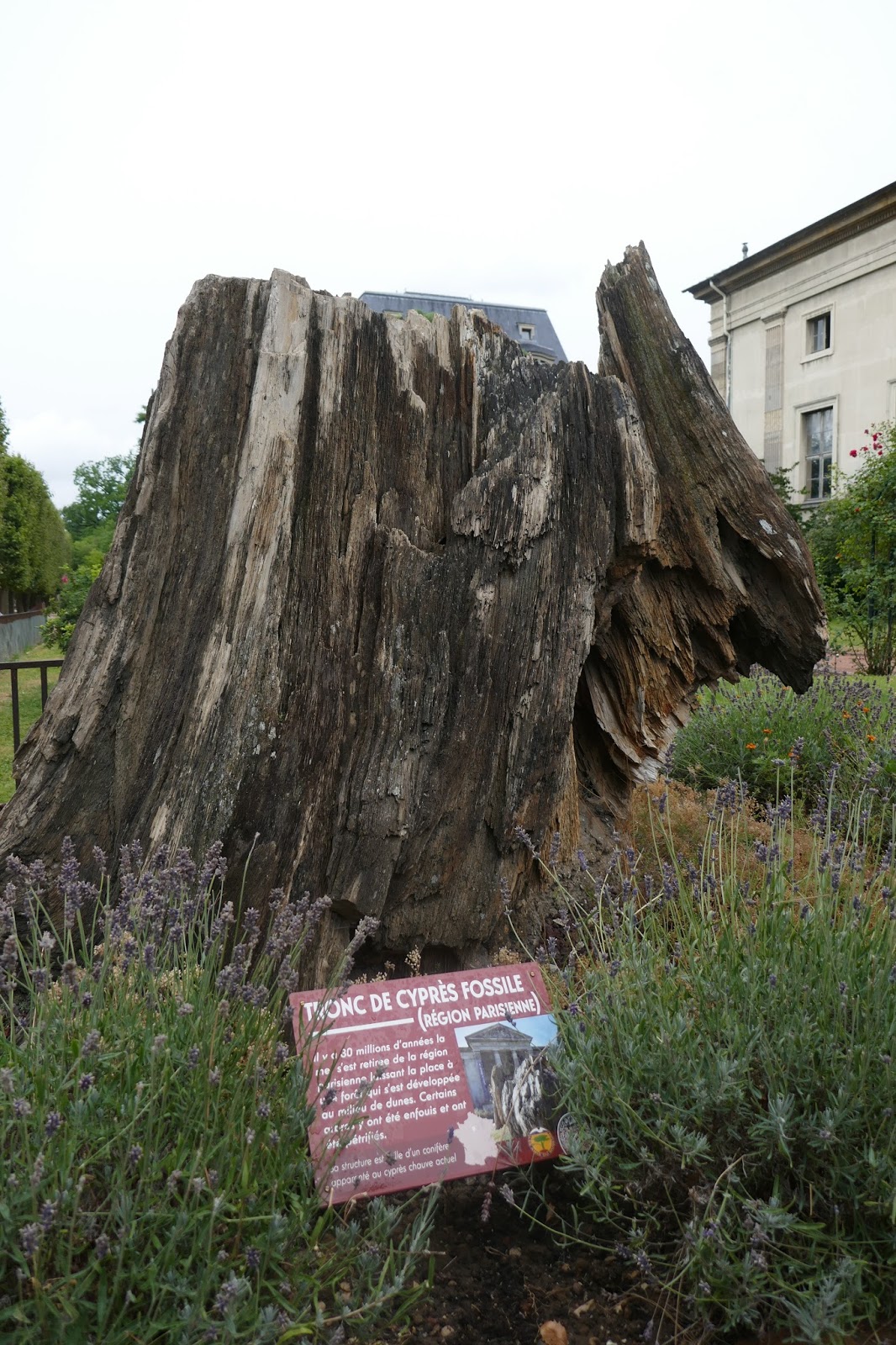
and displays of rock forms,
including a calcified tree.
After leaving the gardens, we crossed the river and walked along the Boulevard de la Bastille ( which runs beside the Bassin de l'Arsenal, a canal off the Seine) until we reached the roundabout which has the Colonne de Juillet at its centre, commemorating the July Revolution of 1830, when King Charles I was replaced by Louis-Phillipe. The French seemed to have loved gold in the past. As usual, on top of the column is a gilded figure, representing freedom.
On one of the walls of the Place de Bastille is a stirring call for patriotism from Charles de Gaulle. Nearby is the Opera Bastille. This area certainly has memeories of France's constant fight for freedom.
Next, we walked up to the Quai de la Megisserie, which is supposed to have lots of pet stores. We only found one, but it had a huge collection of animals, including two very fat, very lazy, shop cats.

All of the dogs and cats were pure bred - no mongrels. Which brings me to one of the things I have noticed in France. In Rennes, the homeless tended to be young, fairly aggressive young men, who looked like they may have drug or alcohol problems, but they tended to be quite tredndily dressed, with mobile phones and fancy earphones. And, they had the nicest dogs I have seen in a long time. The mongrels tended to look like Briard, German shepherd, collie or spaniel crosses, but I saw some that looked like pure-bred huskies and Berger Picards. Where do they get these dogs from? I can never find anything as nice when I go looking! In contrast, the pure bred dogs that I have seen in the streets in Paris and Rennes - Yorkshire terriers, Cavalier King Charles Spaniels, West Highland Whites and Chihuahuas particularly - have seemed to be very badly bred, with hip problems, spindly bodies and an inbred look, though I have seen lovely dogs too - notably some Bernese Mountain Dogs. Looking at the dogs in the pet shop, which is very clean and well looked after, I wonder if most French people buy their pedigreed dogs from pet shops. Apart from the usual, they also sold chinchillas, Korean squirrels,

hamsters, rabbits fish and the most amazing range of birds. They had Australian cockatoos and galahs, lots of conures, all kinds of finches, some beautiful mynahs - the list could go on for a page. I wonder if these birds are all captive bred , or whether there is some illegal smuggling going on.
Going back to the hotel, I thought more about pets in France. I had been told to look out for droppings everywhere, but there aren't really more than I find in Australia. The French are obviously making an effort. I like the way the French can take their dogs everywhere, though I suppose many would not like this. I have seen them in shops, restaurants - even trains. The dogs seem fairly polite. I've only heard one snarl. I have seen no stray dogs and no stray cats. They all seem to have owners. The dogs in Paris seem to be mainly small - I guess this makes sense if you live in a flat- but I have seen an English setter, a German Shepherd, Golden Retrievers and a Labrador. Very few people walk them off lead - even the homeless use leads on their dogs and cats. and they take them on holiday. One couple were trying to take their dog into the church at Mont. Saint Michel!